When the Patriot Act was passed in 2001, and again when the FISA Amendment Act was passed in 2008, several key surveillance powers were supposed to “sunset” in a few years unless Congress voted to reauthorize them. Which Congress has, repeatedly, usually without even introducing significant reforms.
Now it’s the USA Freedom Act’s turn to sunset, on December 15 unless it’s renewed.
Urgency increases as we get closer to the sunset mechanism’s looming deadline — which in turn often leads to short-term extensions. It’s like watching sausage getting made, although with a lot more scary headlines and phone calls to Congress.
So buckle up! The bulk of this post goes into more detail about the situation, but first a few things you can do right now:
Tell Congress: Shut down unlawful surveillance is an easy-to-use forms to ask your Congressional representatives not to extend Section 215, sponsored by organizations including Demand Progress, Fight for the Future, and MediaJustice)
As things heat up there will no doubt be plenty of opportunities for grassroots activism. So, stay tuned! You can follow Get FISA Right on Twitter and Facebook, and of course there are plenty of other great organizations working on this issue.
We have another chance to end this intrusive surveillance!
I got an e-mail from FreePress.net’ action team, calling on supporters to contact our Congressional representatives in yet another attempt to shut down the so-called PATRIOT Act’s Section 215 surveillance authorization. Here is what they have to say about this bill, passed in panic after Sept. 11, 2001.
Since 2001, a critical section of the Patriot Act has allowed the government to collect an astonishing amount of sensitive data about the daily lives of people who live in the United States. And now Congress is debating whether to reauthorize Section 215 and cement the Trump administration’s ability to spy on people without a warrant.
As Edward Snowden revealed, Section 215 allows the government to collect incredibly sensitive information like our phone calls, location data, medical records and financial transactions. Everyone’s personal data can get swept up in Section 215. But we’re not all being surveilled equally.
Mass surveillance is racist in its impact. Instead of targeting the increasing threat of violent white supremacy, the NSA and other federal agencies likely use Section 215 to collect bulk data on Muslim communities, Black political activists and immigrants of color — all without needing to use a warrant or show probable cause.
And right now Congress might buckle to Trump’s demand to make this invasive surveillance authority permanent.
NOTE: this is worse than ever; past reauthorizations were time-limited, which is why we have another chance to sunset this. The current occupant of the people’s White House wants to further his racist agenda by making this extreme government surveillance permanent.
More from FreePressAction:
Leaks in the last month have revealed that the FBI lied about the extent of its tracking of Black activists and was covering up a program called IRON FIST that it created to target and infiltrate racial-justice groups.1 And more recently, news broke that the FBI is treating groups that are protesting the administration’s abhorrent immigration policies at the U.S. border as “extremist organizations.”2 Congress shouldn’t reauthorize these vast spying powers while the FBI is surveilling activists and trying to disrupt the fight for racial justice.
These developments are alarming: We can’t allow government agencies to use sweeping surveillance authorities to go after anyone who opposes the Trump administration’s inhumane policies.
We advocate rejecting the politics of fear, revisit the flawed FISA Amendments law and Patriot Act, and safeguarding the people’s rights under the Fourth Amendment to the U.S. Constitution.
Please, Senator Obama, Say NO to Telecom Immunity and Get FISA Right launched on June 26, 2008, with posts by Mardi on my.barackobama.com and Mike Stark on Open Left. The media hook of Obama supporters using his own social network to pressure him with an open letter got a lot of coverage, and by July 2, we were the biggest group on MyBO. On July 3, Obama responded to our open letter on MyBO – an event that’s often seen as a watershed for social network activism in the US.*
Alas, it wasn’t enough. Obama declined to support the filibuster by Senators Feingold and Dodd. On July 9 2008 Congress passed the FISA Amendments Act – giving the government virtually unrestricted access to collect Americans’ international communications, and granting retroactive immunity to telecoms that had cooperated in illegal Bush-era spying.
Our tenth anniversary’s a good opportunity to check in, reflect on the past and what we can learn, and talk about what next.
So whether or not you were part of it back in the day, we’d love to hear your memories of Get FISA Right – and thoughts about the future of civil liberties activism.
Here’s a few thoughts to kick things off …
The view from 2018
As we predicted in 2008 (and even after the Snowden revelations highlighted the intelligence agencies’ abuse of their power), Congress has repeatedly expanded the scope of warrantless wiretapping – and failed to introduce any meaningful safeguards. With the Trump Administration becoming increasingly authoritarian, and Democratic leadership complicit, risks that seemed abstract or hypothetical to many people a decade ago are overwhelmingly real.
Facebook has made their platform far less useful for activism than it used to be, while instead optimizing it to promote genocide and steal elections, and routinely suspends activists’ accounts (especially women of color)
Twitter has helped the alt-right weaponize their tactics to the point where Amnesty International describes it as “toxic place for women”.
And so on. It’s almost like people with power are scared of what might happen when people organize online and are doing their best to stop it.
Restore the Fourth protest in New York, 2013
Still, as Restore the Fourth reminded everybody in 2013 – and hundreds of thousands of people around the country are once again showing this week at ICE facilities as part of the week of action – grassroots energy remains out there — and people continue to connect on social networks. And as grim as the overall situation is, there’s also been substantial progress in a lot of areas. For example:
Groups like Black Lives Matter, the Water Protectors, and StopLAPDSpying – along with intersectionally-focused leadership in civil liberties coalitions and academia – are increasingly highlighting the relationship of government surveillance to the prison-industrial complex, immigration, racism, and environmental justice.
Momentum has shifted against Facebook and Twitter, and new decentralized platforms like Mastodon may prove to be better environments for civil liberties activists
Explicitly anti-oppressive new projects like Torn Apart / Separados and Douglass, and new tools for activism like Signal, Loomio, SecureDrop, better.place, and Pursuance, are still at a relatively early stage but point the way to new possibilities
Learning from the past – and looking forward
As Get FISA Right heads into its second decade, there’s still a big potential role for grassroots social network activism in the fight for civil liberties – and for justice. There’s a lot to learn from our experiences. What worked? What didn’t? How would we adapt things to today’s, and tomorrow’s environment?
So please share your perspectives – in the comments here, on the Get FISA Right wiki, on social networks like Twitter, Facebook, Medium, Mastodon, and Diaspora, or wherever else works. We’ll collect the responses and follow up with a post in a week or two. In the meantime, help us get the word out by sharing, liking, tweeting, emailing, and otherwise letting people know.
Thanks to everybody who’s been involved with and supported Get FISA Right and the fight for civil liberties over the last decade. Looking forward to the next ten years!
“I’m running for Congress because I can’t watch America’s constitutional crisis from the sidelines. San Francisco’s representative in Washington talks about resistance, but having been in the House for 30 years, she has become a pillar of the Washington establishment. Even worse, she has repeatedly caved under this maniacal President and compromised our rights…. Watching our representative in San Francisco hand expanded domestic surveillance powers to the Trump administration in January 2018 was too much for me to bear.”
Shahid’s been on the front lines of the fight against warrantless surveillance since even before Get FISA Right started in 2008. He worked very closely with us during his years at Bill of Rights Defense Committee – and with other grassroots civil liberties organizations like Restore the Fourth. More recently, he’s been at EFF and on the board of Center for Media Justice. Now, he’s taking things to the next level and running for Congress in San Francisco … for the seat currently held by Nancy Pelosi.
Every Member of Congress had the opportunity to decide whether to protect Americans’ privacy, and shield vulnerable communities from unconstitutional targeting, or to leave broad spying authority in Trump’s—and Jeff Sessions’—hands.
A surprising number of Republicans opposed a straightforward FISA reauthorization bill this year – enough that there was a chance to get some meaningful reforms. Instead, Pelosi and dozens of other Democrats voted to expand the NSA’s warrantless surveillance powers. Talk about caving and compromising our rights …
Of course, Shahid’s strong position on surveillance is only part of his platform; ShahidForChange.us also highlights issues like reducing government and corporate corruption, reducing military spending to save social services, and ending federal prohibition of cannabis. Still, all the polls show that the majority of Americans oppose warrantless wiretapping — and my guess is that the percentage is even higher in San Francisco. So it’s great to see a pro-civil liberties candidate making it a big part of their platform.
A few years ago on one of the Get FISA Right phone calls we were lamenting how politicians continue to shrug their shoulders at the NSA’s ongoing pattern of misleading Congress and avoiding any kind of oversight, and I remember saying “things won’t change until the civil liberties vote makes the difference in elections.” Now’s as good a time as any to start!
Tweet at your Congressmember today to prevent a sneak vote for mass surveillance!
In the House, surveillance hawks are trying to ram through a bill extending mass surveillance, without time for debate or amendment.
If we can delay or defeat this vote, every day will make a huge difference in this fight. Section 702—the legal authority the NSA relies on to engage in this mass surveillance—theoretically expires in 12 days; the closer we get to that deadline, the more leverage we have to pass real reforms.
The vote on this is likely to happen today, so there’s no time to make phone calls or send emails. Please tweet at your members of Congress using www.decidethefuture.org and urge them to vote NO on H. R. 4478.
Many thanks to Restore the Fourth for providing this timely notice to their subscribers, and apologies for reposting it here, but we are a shoestring volunteer group. We encourage our readers to get involved with Restore the 4th , which works to protect us from overreaching, unconstitutional mass government surveillance.
As Congress debates the “USA Liberty Act”, it is important to consider the implications for warrantless, back-door searches. The following information comes from the Brennan Center (https://www.brennancenter.org/blog/congress-cant-compromise-privacy); the entire article is worth reading to fully understand the importance of this issue and Section 702.
[T]he problem with the USA Liberty Act’s solution is not simply that it does not go far enough. In two key respects, it actually represents a step backward.
First, it would put Congress’s stamp of approval on backdoor searches. As it stands, Section 702 does not expressly authorize agencies to search for Americans’ communications. Indeed, the practice seems inconsistent with the law’s prohibition on targeting Americans, not to mention its requirement that the government minimize the retention and use of Americans’ communications. By codifying backdoor searches for foreign intelligence purposes, the USA Liberty Act would make the law worse, even if it improved on the government’s actual practice.
Even more worrisome, the USA Liberty approach would introduce a new and dangerous principle into the law: the notion that Americans have lesser rights when the government is acting with a “foreign intelligence” purpose. Currently, if the government wants to target an American directly for surveillance, it must obtain a warrant regardless of its motive. In criminal cases, the government typically obtains the warrant from a magistrate judge, while in foreign intelligence investigations, it applies to a special court known as the FISA Court. In both cases, however, the government must show probable cause of illicit activity.
There is no principled basis for lowering the standard of protection in foreign intelligence cases and allowing the government to access through the back door what it could not obtain through the front.
With only a few months left before the deadline to reauthorize Section 702 of the FISA Amendments Act, the battle lines are starting to shape up. FISA provides the legal basis for warrantless surveillance, and when it was originally passed over strenuous objections from civil libertarians in 2008, it included a “sunset clause”. After being extended once in the lame-duck session in late 2012, Section 702 will sunset if it’s not reauthorized again by the end of the year.
After a year of high-profile coverage of the pitfalls of mass surveillance, and a lot of criticism of intelligence agency abuse and incompetence across party lines, you’d think that there would be bipartisan interest in getting some meaningful reforms. So far, though, the two options on the table are “bad” and “worse”:
Sigh. EFF’s Pull the Plug on Internet Spying Programs offers an easy way to contact your Congresspeople. And, if you’re calling for some other reason, take a few minutes to ask them to oppose USA LIBERTY, reauthorization without change, and making 702 permanent.
But, it’s far from over. Encouragingly, Ron Wyden and Rand Paul are planning to introduce an amendment to require a warrant for searches of incidentally collected information – a reform supported by a broad alliance of human rights and civil liberties organizations.* And especially if that amendment isn’t adopted, it’s possible that either the House or the Senate won’t pass an extension – which would be a very good thing for civil liberties.
EFF’s excellent resource on Decoding 702 has a good overview of the problems with FISA 702. When Get FISA Right first started almost a decade ago, a lot of these seemed hypothetical. In 2017, thanks to General Flynn, Paul Manafort, and the DC culture of leaking, real-world examples are in today’s headlines. As a result, a lot of Republicans who previously have been pro-surveillance are having some qualms as well about the issues civil liberties advocates have focused on for years. For example:
“Incidental collection“, where US citizens’ information is “accidentally” collected along with the foreign citizens being targeted
A series of “deeply troubling” leaks from the intelligence services to the press
The battle over Patriot Act reauthorization in 2015 showed that the alliance of progressives, libertarians, and Tea Partiers is strong enough to have an impact if they stick to their guns. Lawfare‘s detailed analysis of support for Section 702 in the Senate suggests that in addition to Rand Paul, up to a dozen Republican Senators might not support reauthorization without reforms. Then again, there are quite a few Democratic Senators who routinely support mass surveillance.
When the bills start to move forward and activists crank up “call your representatives!” campaigns, it might well be the first time Indivisible and the Tea Party find themselves on the same side of an issue — working with the Center for Media Justice, Cato Institute, the American Library Association, and other strange bedfellows. For the first time in years, the political winds may actually be aligning for surveillance reform. And there’s certainly a lot of grassroots energy out there.
Since then, grassroots activism has really showed its strength on other issues – most notably the health care battle. Indivisible, with its emphasis on creative protests and in-person meetings with staffers as well as phone campaigns, is particularly well-positioned to pressure wimpy Democrats to hold the line on civil liberties – and to build on its successes pressuring potentially-wavering Republicans. Center for Media Justice and Color for Change have built deep connections with the civil liberties community. Longtime stalwarts like EFF, ACLU, Defending Rights & Dissent, and the ALA – and grassroots civil liberties groups like Restore the Fourth and Get FISA Right – continue to fight as well. Will it be enough?
* Including EFF, Center for Media Justice, Color of Change, the Arab-American Anti-Discrimination Committee, the ACLU, the American Library Association, Restore the Fourth, Defending Rights and Dissent, EPIC, CDT, the National Center for Transgender Equality, the NAACP, the National Immigration Law Center, and Demand Progress. Broad-based indeed!
Almost a decade after Get FISA Right was born, Section 702 of the FISA Amendments Act is once again up for reauthorization. FISA provides the legal basis for warrantless surveillance, and when it was originally passed over strenuous objections from civil libertarians in 2008, it included a “sunset clause”. After being extended once in the lame-duck session in late 2012, Section 702 will sunset if it’s not reauthorized again by the end of the year.
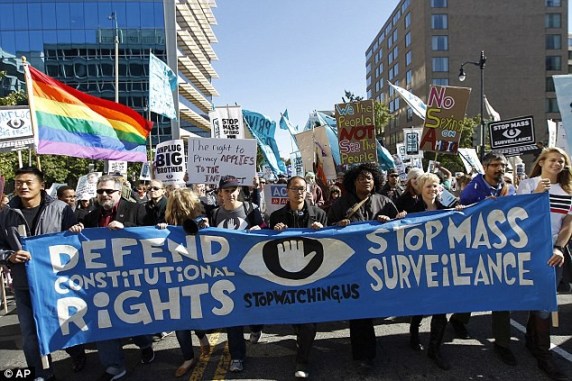
Stop Watching Us demonstration in DC, 2013, photo from the Daily Mail
This is not directly related to our core FISA issue of warrantless wiretapping, but it is clearly of importance to those of us who appreciate truth in media and journalistic standards that include independence and honesty, who prefer our editorial opinions on the Op-Ed page (or Web0site equivalent), not disguised as “hard news”, which we expect to be fact-based reporting.
It was called the “Ministry of Truth” by George Orwell, and some suggest that it is coming to the U.S.A. State Department, authorized by an amendment to a defense authorization bill that allows the federal government to spread propaganda not just internationally, as it has long done, but also domestically‚ to U.S.A. citizens, using materials created for foreign audiences in support of government policies that might be unpopular here at home—wars, for instance.
The bipartisan bill, which was introduced by Senators Portman and Murphy in March, will . . . .establish an interagency center housed at the State Department to coordinate and synchronize counter-propaganda efforts throughout the U.S. government. To support these efforts, the bill also creates a grant program for NGOs, think tanks, civil society and other experts outside government who are engaged in counter-propaganda related work. (http://www.zerohedge.com/news/2016-12-24/obama-signs-countering-disinformation-and-propaganda-act-law)
Here is an article with more information: http://vigilantcitizen.com/latestnews/new-bill-legalizes-government-propaganda-and-disinformation-on-american-citizens/
and, from that article, this:
The bill’s supporters say the informational material used overseas to influence foreign audiences is too good to not use at home, and that new techniques are needed to help fight Al-Qaeda, a borderless enemy whose own propaganda reaches Americans online.
Critics of the bill say there are ways to keep America safe without turning the massive information operations apparatus within the federal government against American citizens.
This amendment would
essentially neutralize two previous acts—the Smith-Mundt Act of 1948 and Foreign Relations Authorization Act in 1987—that had been passed to protect U.S. audiences from our own government’s misinformation campaigns.
Interestingly, the Smith-Mundt Act was passed shortly after the end of World War II—presumably to rein in the war-propaganda machine?
It seems to me that something so substantial deserved more attention than it was given, both when passed by the Senate back in March and at its passage by the House of Representatives on the Friday before Christmas and quick signature by the president that same day. It is disturbing that this was quietly done, as described in that same article:
“I just don’t want to see something this significant – whatever the pros and cons – go through without anyone noticing,” says one source on the Hill, who is disturbed by the law. According to this source, the law would allow “U.S. propaganda intended to influence foreign audiences to be used on the domestic population.”
The new law would give sweeping powers to the government to push television, radio, newspaper, and social media onto the U.S. public. “It removes the protection for Americans,” says a Pentagon official who is concerned about the law. “It removes oversight from the people who want to put out this information. There are no checks and balances. No one knows if the information is accurate, partially accurate, or entirely false.”
In a society that relies so completely on checks and balances, on oversight, it is troubling in the extreme to see current limitations removed—particularly just before the inauguration of a president-elect noted for misrepresentations and extremist rhetoric in his use of media.
This post is more a request for information than a provision of same.
I was discussing cell-phone privacy, and a friend mentioned that since the World Trade Center attacks all cell phones have GPS location devices that are trackable even when off. I was not sure of the accuracy of that statement (though we all know that the so-called PATRIOT Act was a vast overreaction and overreach), so I went hunting for current law.
I did not find much; I did find a government site from 2014 that had a link to a page about pending legislation; that page was updated 2 months ago (28 Oct. 2016). Here is the link: http://www.gps.gov/policy/legislation/gps-act/
The original page (www.gps.gov/policy) also had information on the 2012 Jones decision and on lower-court rulings, including one that required a warrant for GPS-based vehicle trackers (later vacated and to be reheard, according to the site today [26 Nov. 2016]).
I think we have some work to do, between all the other ball-juggling that is happening: Electoral College, vote recounts, proposals for mass registration and deportations, Dakota Access water-protector repression, racist appointments, etc. Already, many folks are talking about the need for encrypting e-mails and phone conversations/messages—is that actually useful, or just an illusion because Internet Service Providers give everything to the government, anyway?
The right of the people to be secure in their persons, houses, papers, and effects, against unreasonable searches and seizures, shall not be violated, and no Warrants shall issue, but upon probable cause, supported by Oath or affirmation, and particularly describing the place to be searched, and the persons or things to be seized